From Hand to Hand

A Shared Wearable Interface and Functional Benchmark for Dexterous Manipulation

Qiandao Liu*, Shengmiao Samuel Jin*, Laura Ren, Tapomayukh Bhattacharjee

Cornell University · *Equal contribution

Workshop on Dexterous Manipulation · CoRL 2026

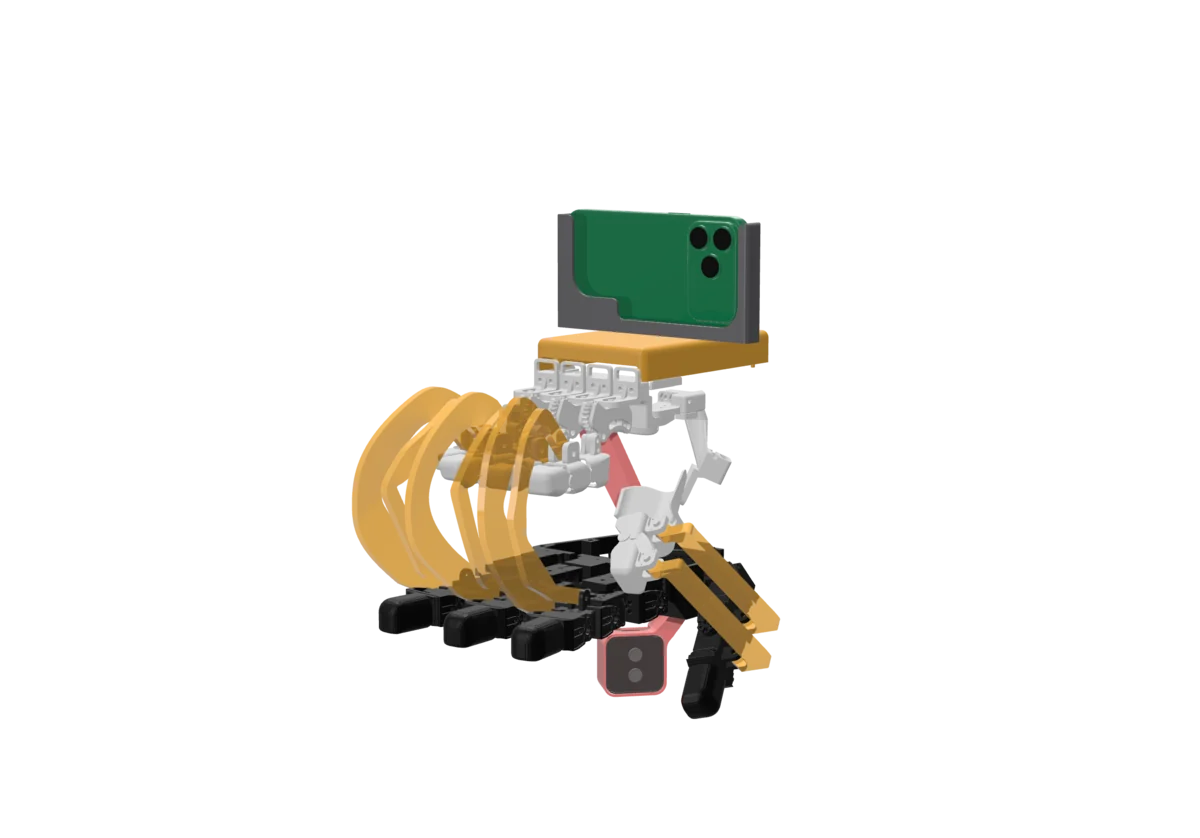
One shared sensorized exoskeleton, interchangeable passive hands: WuDi reuses the same sensing hardware across robot hands.

This video includes audio.


Poster

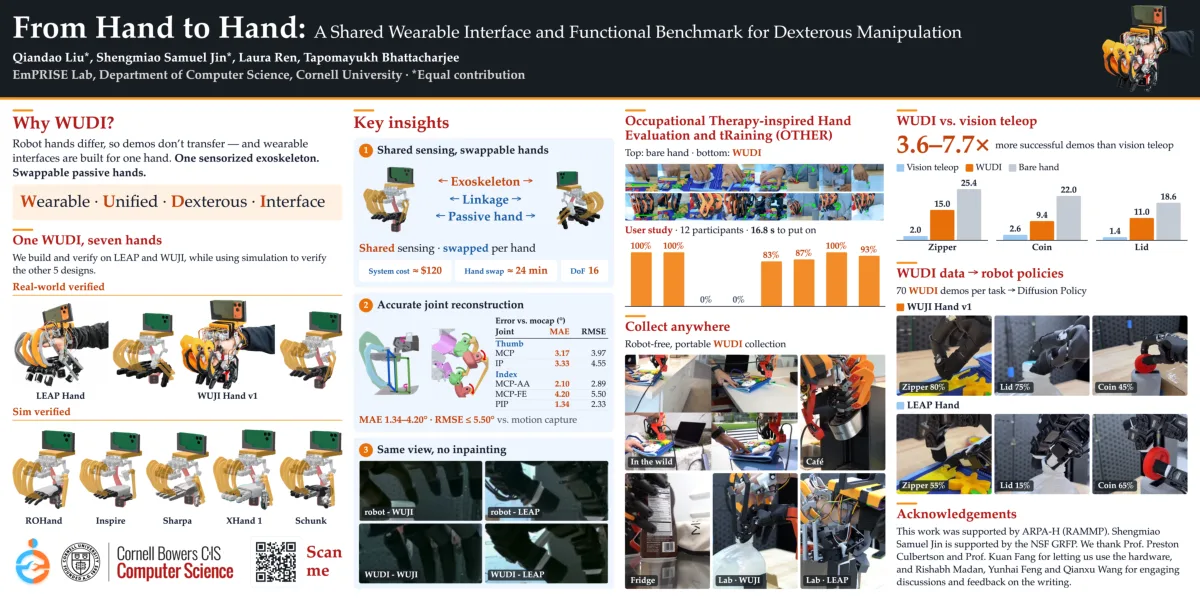
WuDi poster for the Workshop on Dexterous Manipulation at CoRL 2026. Open the PDF for the full-resolution version.

Open poster · PDF, 6 MB


Abstract

Collecting dexterous manipulation demonstrations across robot hands often requires embodiment-specific sensing hardware or human-motion retargeting. We present WuDi, a Wearable, Unified Dexterous Interface that separates a shared sensorized exoskeleton from interchangeable passive hands and linkages. Its 16 sensors remain on the exoskeleton, while a mechanism model reconstructs target-hand joint positions. Wrist images and poses enable robot-free demonstration collection. We also introduce OTHER, an eight-task benchmark inspired by occupational therapy for evaluating functional manipulation. We fabricate WUJI and LEAP configurations, assess usability with 12 participants using WUJI, and validate joint reconstruction on the LEAP thumb and index finger against motion capture. Separate policies trained from 70 demonstrations per task–hand pair achieve 15%–80% success across three tasks, with 20 rollouts per pair. For one expert operator using LEAP, WuDi provides higher collection throughput than vision-based teleoperation. These results support shared sensing across embodiments while exposing limitations in reachable motion, contact-force regulation, and passive-hand mechanics.

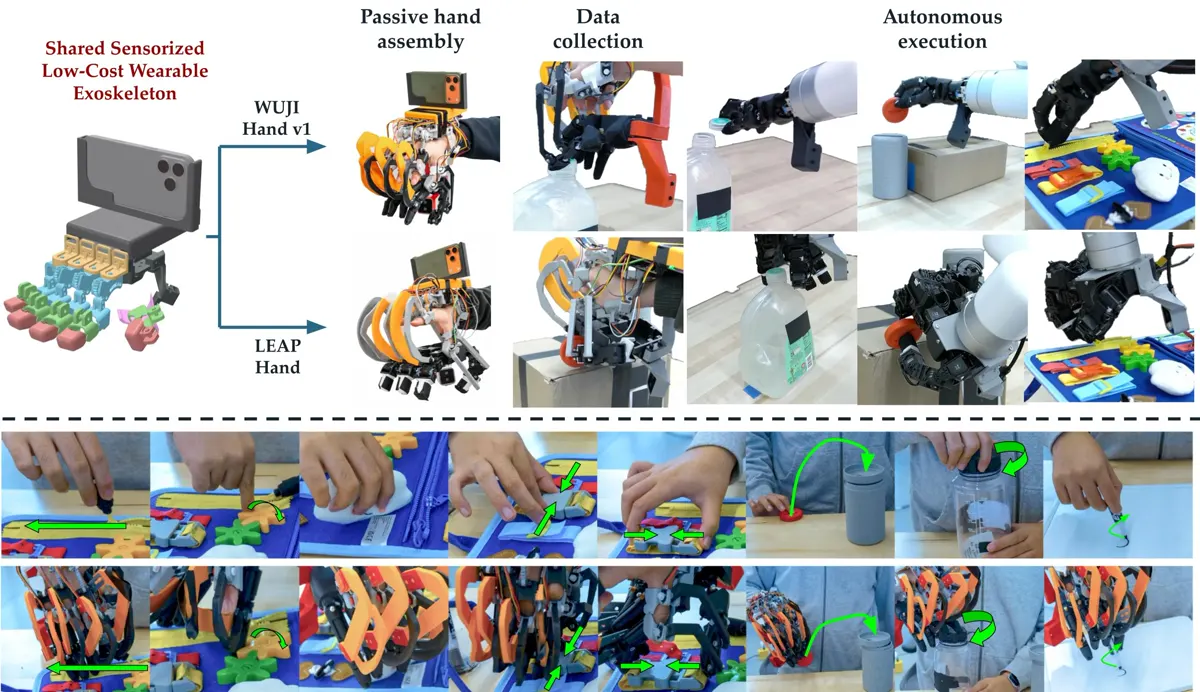
Overview of WuDi: shared sensorized exoskeleton, passive-hand assembly, data collection, autonomous execution, and the OTHER tasks.
Shared sensing across WUJI Hand v1 and LEAP Hand, from collection to autonomous execution.

WuDi

WuDi (Wearable, Unified Dexterous Interface) supports collection in everyday environments after brief familiarization. On LEAP Hand, an expert operator achieves 3.62–7.71× more successful completions per five-minute window than vision-based teleoperation on Zipper, Coin, and Lid.

In the wild · Portable collection
Café · Everyday setting
Fridge · Everyday setting

Explore & Extend WuDi

Inspect how the shared WuDi exoskeleton adapts to six robot hands through embodiment-specific couplers and mounts. Pick a hand to load its CAD; drag to rotate.

LEAP Hand Real-world verified
Loading 3D model…


Mechanical Interface

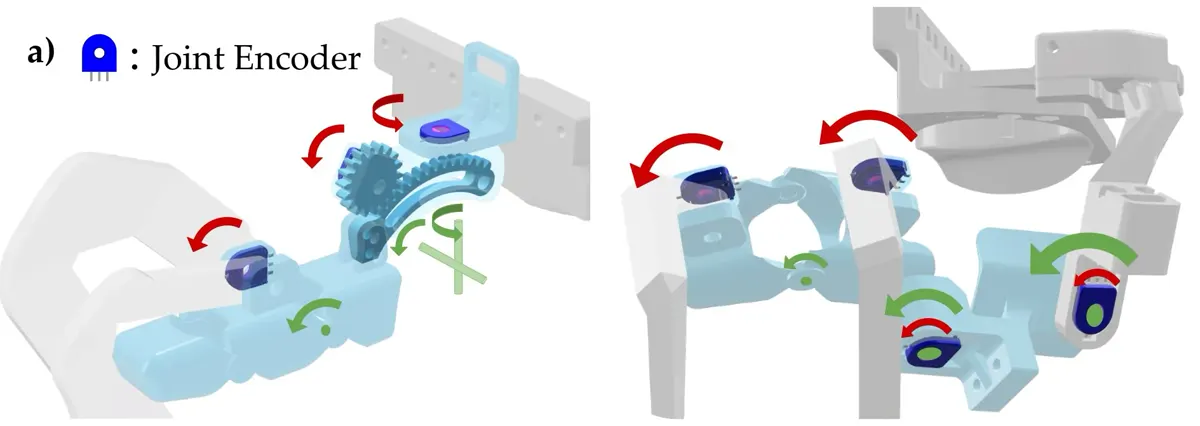
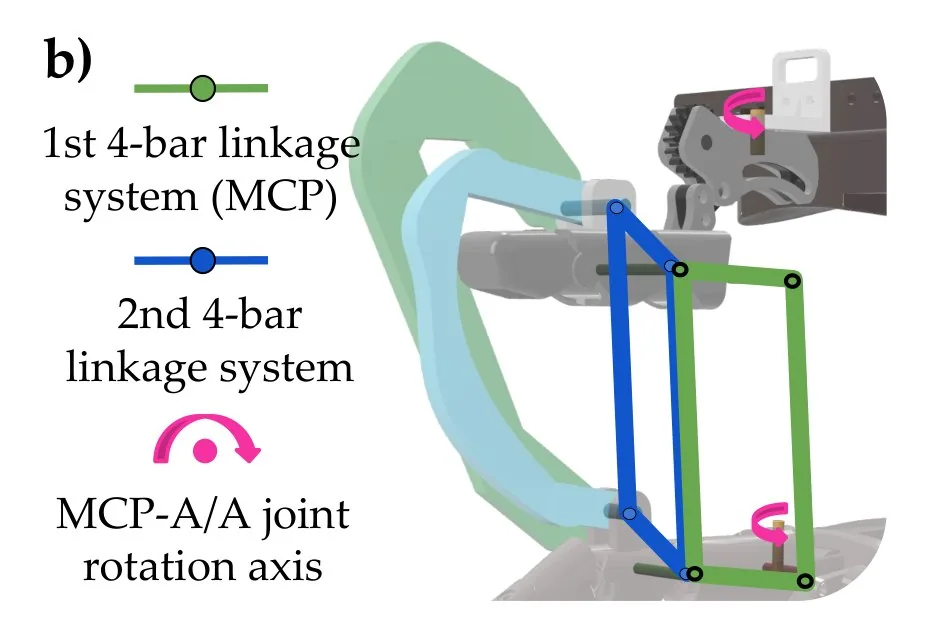
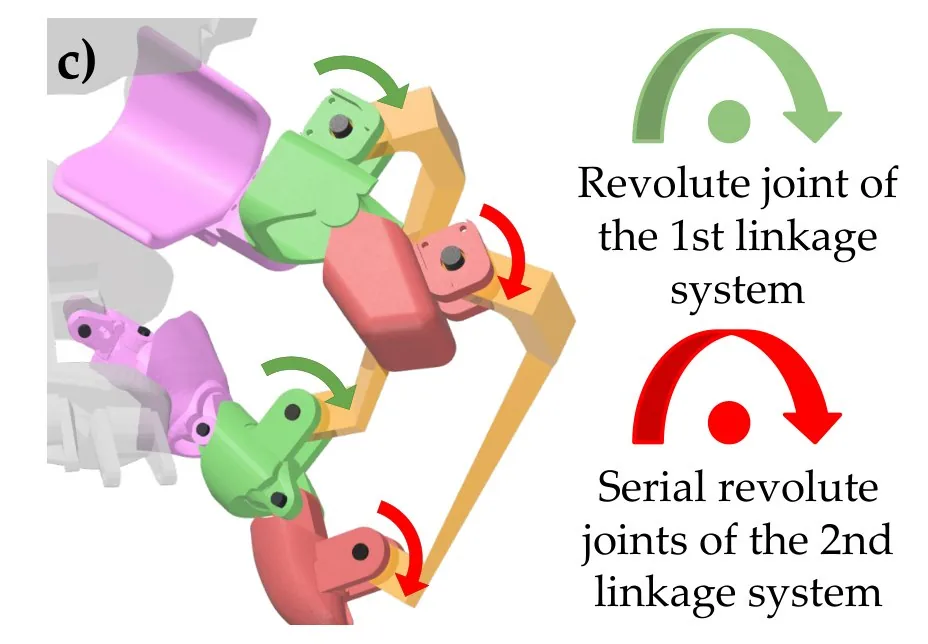
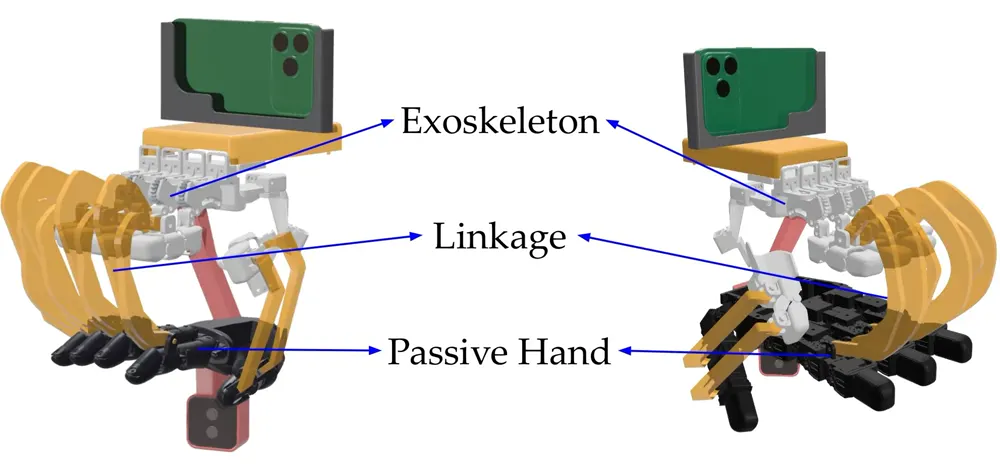
Three components implement the separation of sensing and embodiment: a shared exoskeleton (16 resistive rotary sensors, ~$120 sensing assembly), interchangeable passive hands derived from target kinematics, and embodiment-specific four-bar linkages that transmit MCP/PIP flexion.

The three components of WuDi for WUJI Hand v1 (left) and LEAP Hand (right): exoskeleton, linkage, and passive hand.

WUJI Hand v1 (left) · LEAP Hand (right). A shared sensorized exoskeleton connects to interchangeable passive hands through embodiment-specific linkages.

Explore a component:

16

resistive rotary encoders

15DoF

operator-side degrees of freedom

~$120

sensing system, excluding phone and camera

6DoF

wrist pose from the iPhone's ARKit

2

serial four-bar linkages per finger

D405

RealSense RGB-D wrist camera

Build it: PCB, BOM, printing & firmware →


Reconstruction & Workspace

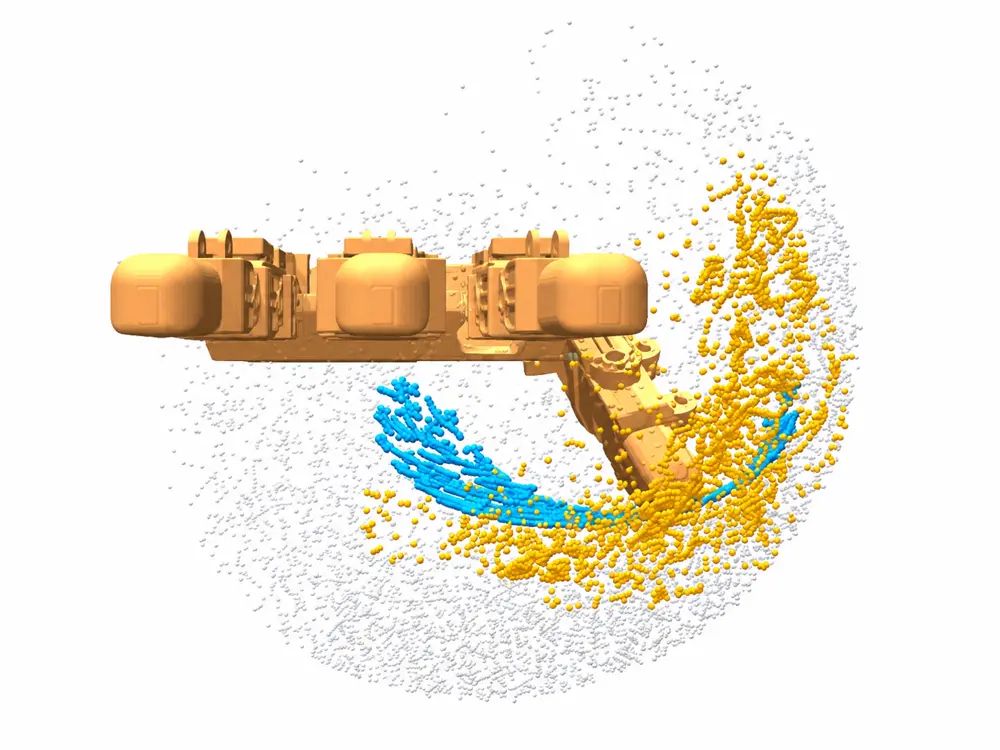
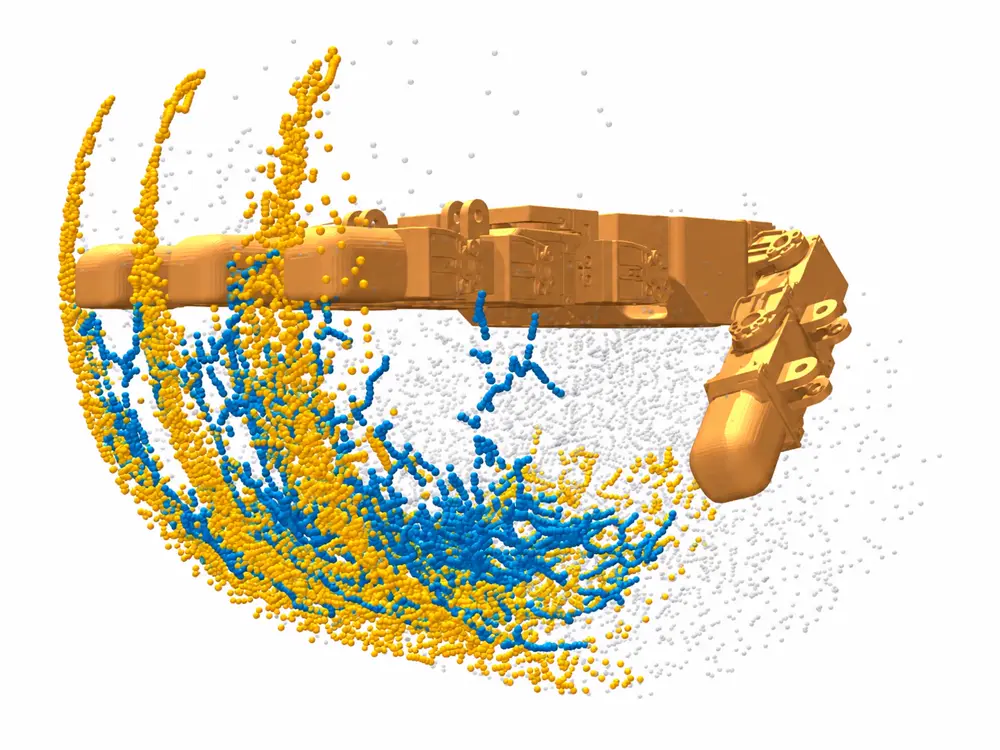
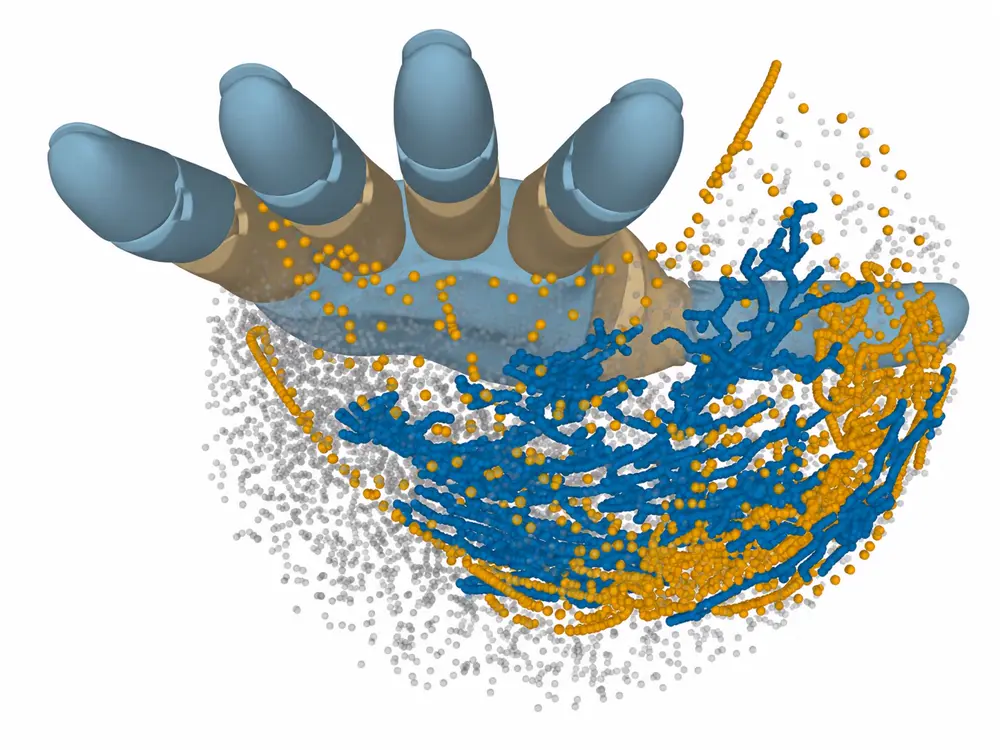
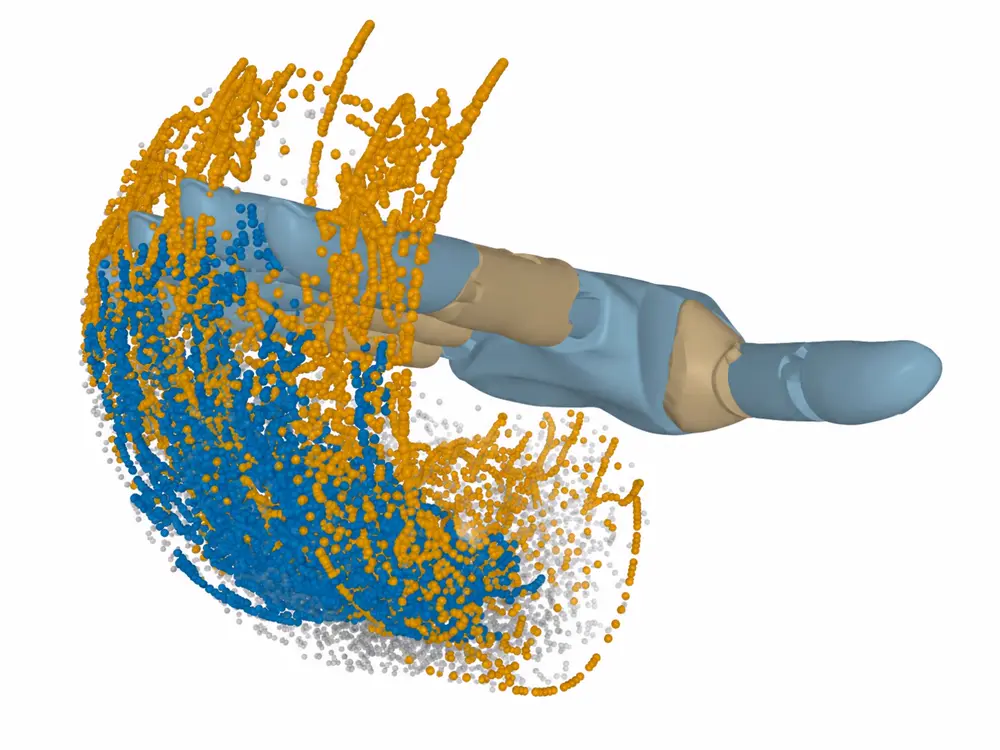
Mechanism-based reconstruction on LEAP recovers passive-hand joint angles with MAE 1.34°–4.20° and RMSE ≤ 5.50°. Motion capture validates the reconstruction; workspace bars compare WuDi with Vision teleop.

Motion-capture validation

Index finger
Thumb

Fingertip workspace coverage

Normalized against Vision teleop = 1.0

LEAP Hand

Thumb0.27×
Non-thumb0.84×

WUJI Hand v1

Thumb0.83×
Non-thumb0.58×
Native workspace WuDi feasible samples Vision teleop
LEAP Hand0.27× thumb · 0.84× non-thumb
LEAP Hand thumb workspace: native samples in gray, WuDi feasible samples in blue, and Vision teleop samples in yellow.
Thumb
LEAP Hand non-thumb workspace: native samples in gray, WuDi feasible samples in blue, and Vision teleop samples in yellow.
Non-thumb
WUJI Hand v10.83× thumb · 0.58× non-thumb
WUJI Hand v1 thumb workspace: native samples in gray, WuDi feasible samples in blue, and Vision teleop samples in yellow.
Thumb
WUJI Hand v1 non-thumb workspace: native samples in gray, WuDi feasible samples in blue, and Vision teleop samples in yellow.
Non-thumb

Benchmark

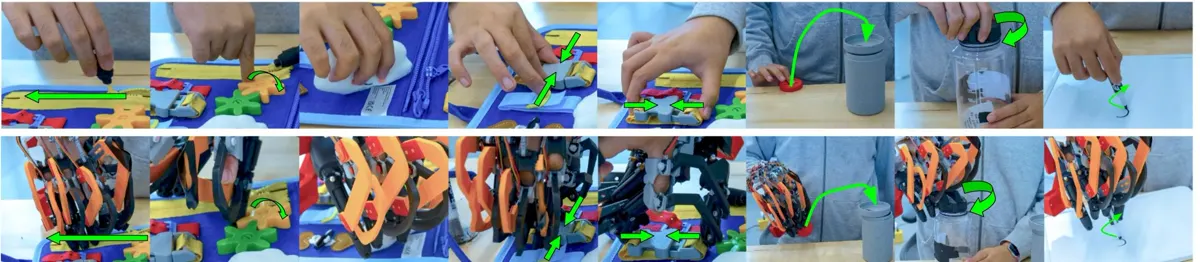
(Occupational Therapy-inspired Hand Evaluation and tRaining) is an eight-task suite for functional dexterity during human-operated demonstration collection and autonomous execution. Tasks span precision grasp (Coin), grip–torque (Lid), tool use (Write), constrained pulling (Zipper), rotation (Spin), compression (Squeeze), and fastening (Buckle / Unbuckle).

Eight OTHER tasks performed bare-handed and with WuDi.
Zipper · Spin · Squeeze · Unbuckle · Buckle · Coin · Lid · Write

User Study

A 12-participant study with the WUJI Hand v1 configuration measured usability and task performance. Donning took 16.8±6.3 s. Success reached 100% on Zipper, Spin, and Lid; no successes were observed on Squeeze or Unbuckle under the optional-continuation protocol. Perceived success averaged 3.83/5.

12

participants

16.8± 6.3 s

to put WuDi on

3.83/ 5

perceived success

User-study montage · 30× speed

Policy Learning Across Hands

We collect 70 demonstrations per task–hand pair and train Diffusion Policy with wrist RGB and relative EE pose. Policies are evaluated on Zipper, Lid, and Coin for both WUJI Hand v1 and LEAP Hand on a UFactory xArm 6.

WUJI Hand v1

Zipper16/20 · 80%
1×
10× · 20 trials
Lid15/20 · 75%
1×
10× · 20 trials
Coin9/20 · 45%
1×
10× · 20 trials

LEAP Hand

Zipper11/20 · 55%
1×
10× · 20 trials
Lid3/20 · 15%
1×
10× · 20 trials
Coin13/20 · 65%
1×
10× · 20 trials

Acknowledgements

This work was supported by ARPA-H (RAMMP). Shengmiao Samuel Jin is supported by the NSF GRFP. We thank Prof. Preston Culbertson and Prof. Kuan Fang for letting us use the hardware, and Rishabh Madan, Yunhai Feng and Qianxu Wang for engaging discussions and feedback on the writing.