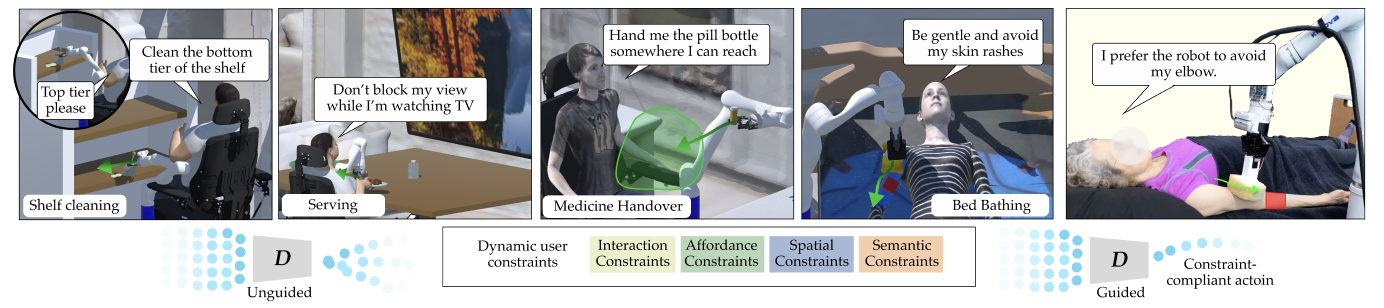
Robots operating in unstructured environments must satisfy dynamic constraints that can change across tasks and even within a single execution. While diffusion policies can learn multimodal behaviors from demonstrations, adapting a trained policy at runtime to newly encountered or evolving constraints remains an open challenge.
We propose RAG-Diff (Retrieval-Augmented Guided Diffusion), a runtime adaptation framework for a frozen transformer diffusion policy that leverages retrieval-augmented memory. RAG-Diff maintains PrefMem, a memory bank of vision-language embeddings paired with (i) state-action snippets and (ii) constraint annotations. At test time, RAG-Diff retrieves the nearest entry and uses it to steer sampling in two complementary ways: I-Atten (In-place Attention recomputation) injects the retrieved snippet as additional cross-attention memory tokens with a classifier-free-guidance-style update, while a predictive value-guidance mechanism uses the retrieved constraint parameters to discourage violations during sampling.
We demonstrate RAG-Diff in physical robot caregiving, a domain with personalized, time-varying constraints — benchmarking on an adapted PushT environment and a suite of caregiving tasks (bed bathing, medicine delivery, shelf cleaning, feeding) spanning interaction, affordance, spatial, and semantic preferences, in both RCareWorld simulation and on a real robot, plus a real-world user study. RAG-Diff improves both task success and constraint satisfaction over unguided diffusion and other guidance- or sampling-based baselines.
We first train a transformer-based diffusion policy on offline demonstrations, following Diffusion Policy. We then steer the frozen policy at test time using PrefMem, a preference memory pool initialized from the same demonstrations. At each timestep, a frozen VLM encodes the recent observation history and retrieves the nearest PrefMem entry — a state-action snippet plus its constraint annotation — which steers denoising in two complementary ways:
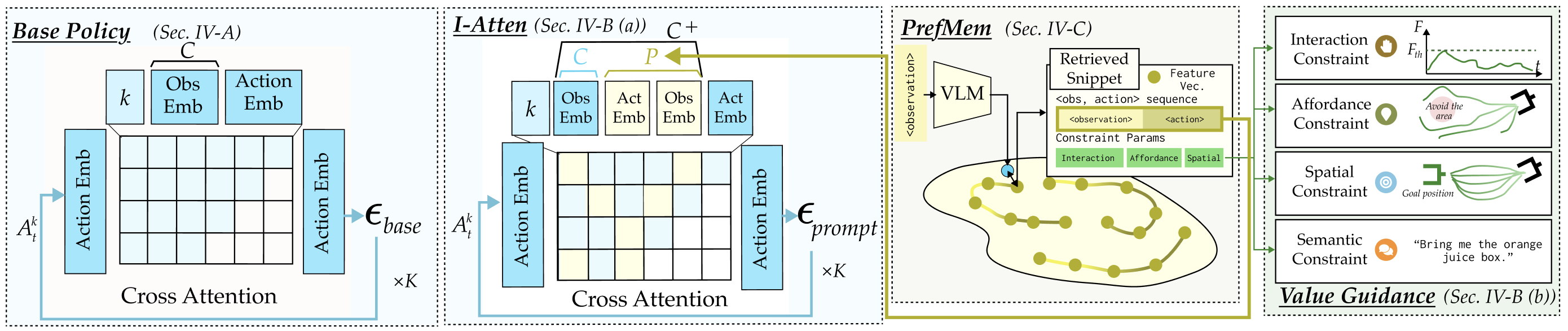
Each constraint is a differentiable value function measuring violation over a candidate trajectory; multiple constraints compose via weighted summation.
Personalized contact-force threshold, e.g. for comfort during bed bathing.
Spatial restrictions on where the robot may act, e.g. avoiding a rash-prone region.
A target end-effector position, e.g. within the user's reachable range of motion.
Language requests grounded via VLM text-to-image retrieval, enforced with value guidance.
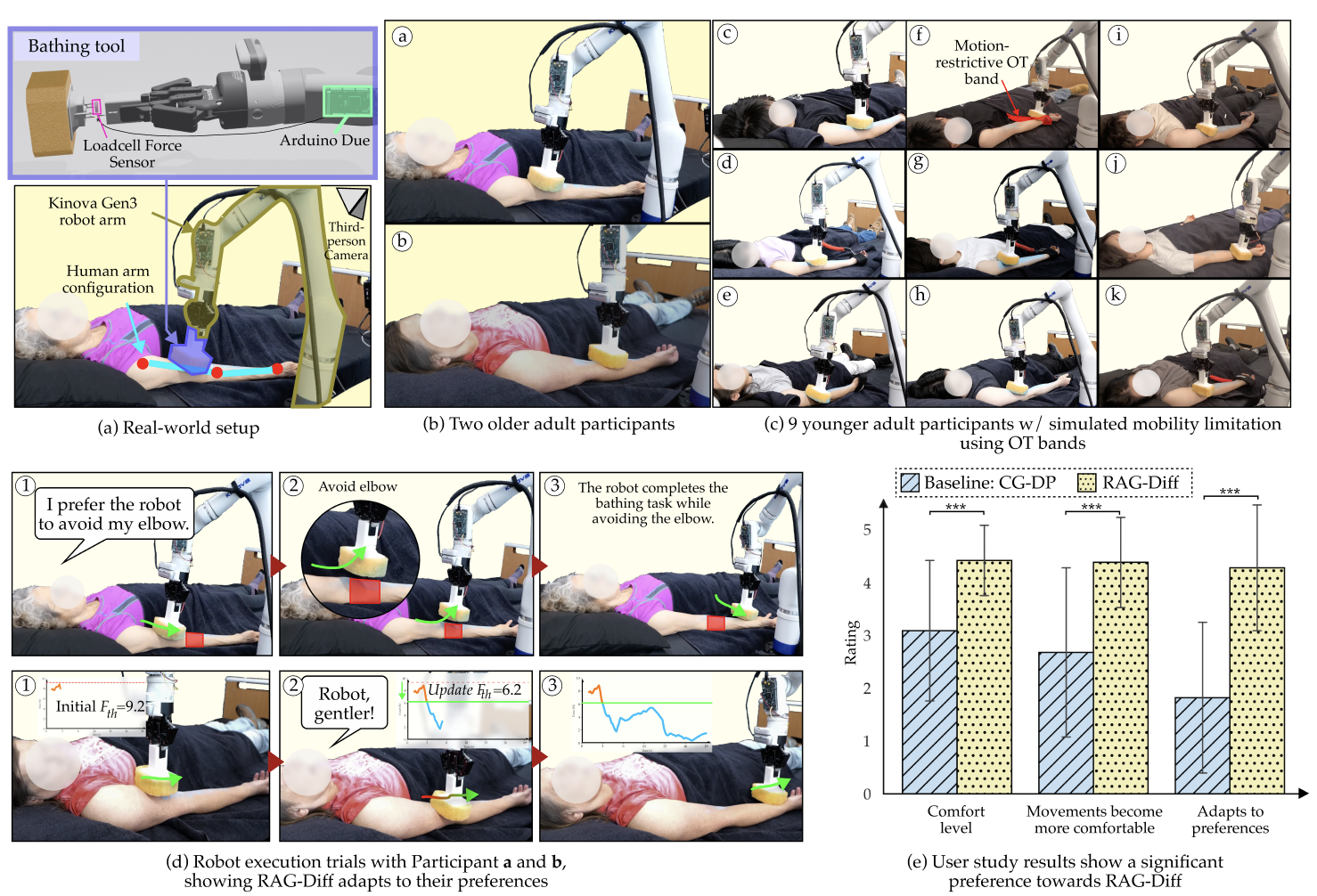
"Old ladies have sensitive skin. I appreciate the robot following my preferences and being gentle
with me."
"The robot really feels like it's listening to me and responding to what I need."
RAG-Diff grounds natural-language preferences (e.g., "Bring me the orange juice box") via text-to-image retrieval in the VLM embedding space — a capability none of the baselines support. It succeeds in all trials (5/5) with distinctive descriptions, though it can degrade under visual or linguistic ambiguity.
"Bring me the orange juice box."
"Bring me the Coke can."
Performance depends on retrieval quality — misleading retrieval (visually similar but semantically different contexts) can yield wrong preference labels or noisy action snippets — and is sensitive to guidance hyperparameters. Retrieval assumes visually similar contexts imply similar actions and preferences, which can fail for latent, non-visual factors. Constraints are enforced as soft guidance, not hard safety guarantees; real-world deployment should add hard safety guardrails.
@article{ye2026ragdiff,
               title  = {RAG-Diff: Adapting Diffusion Policies to Dynamic Constraints with Retrieval-Augmented Guidance},
               author = {Ye, Ruolin and Ha, Nayoung and Chen, Shuaixing and Liu, Qiandao and Chen, Gavin and Stassen, Shaoyang and Zolotas, Mark and Barreiros, Jose and Bhattacharjee, Tapomayukh},
               year = {2026}
          }