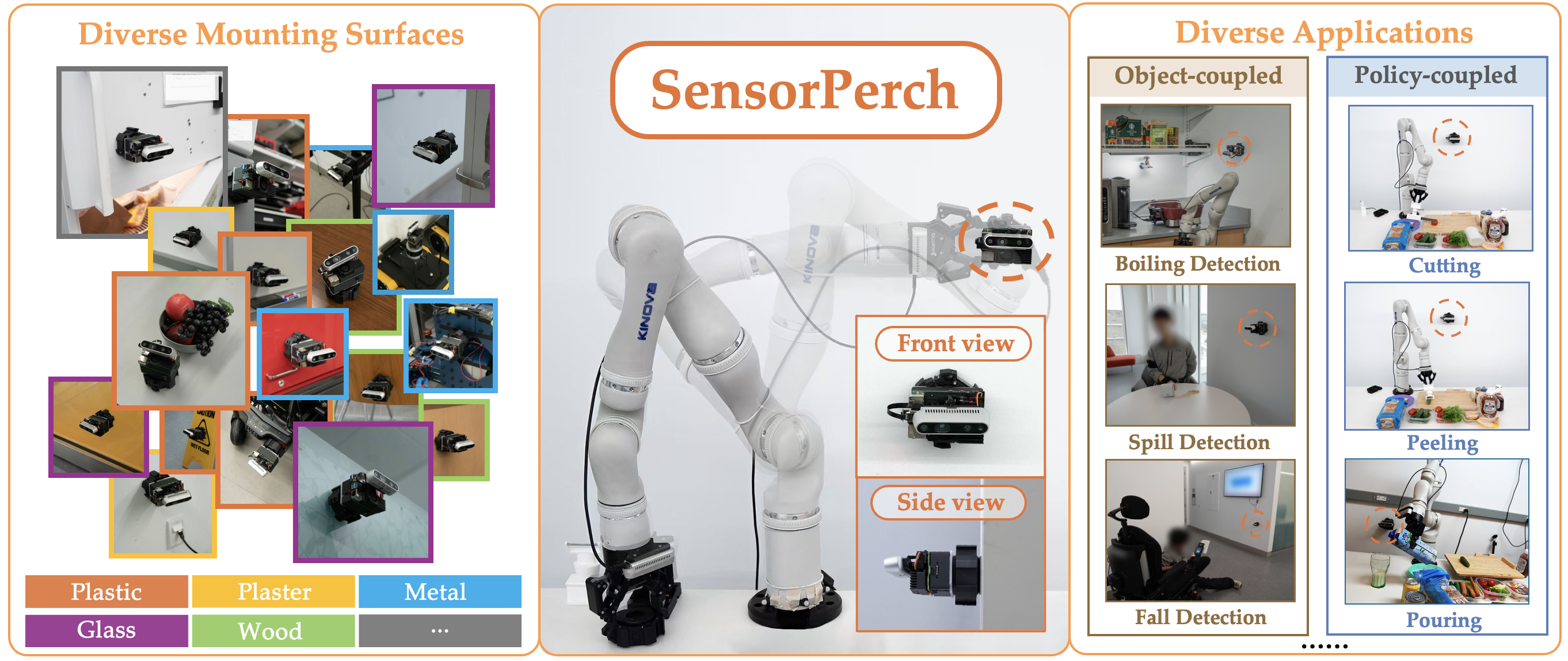
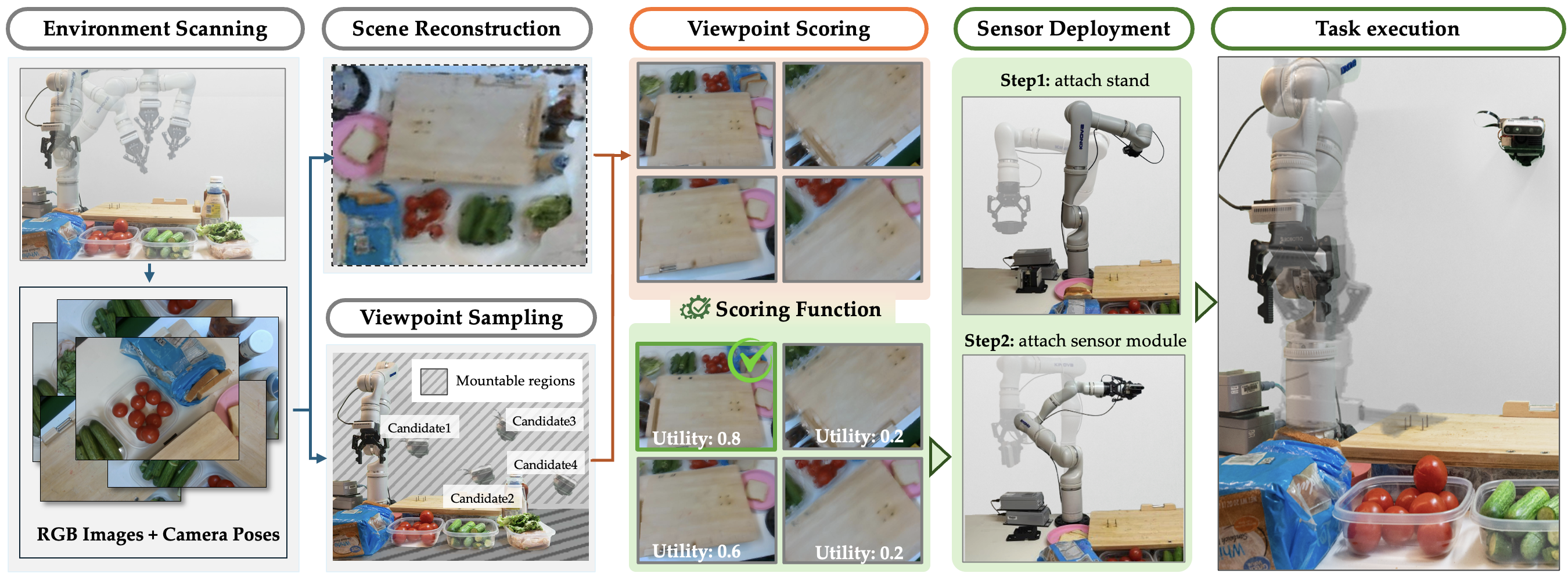
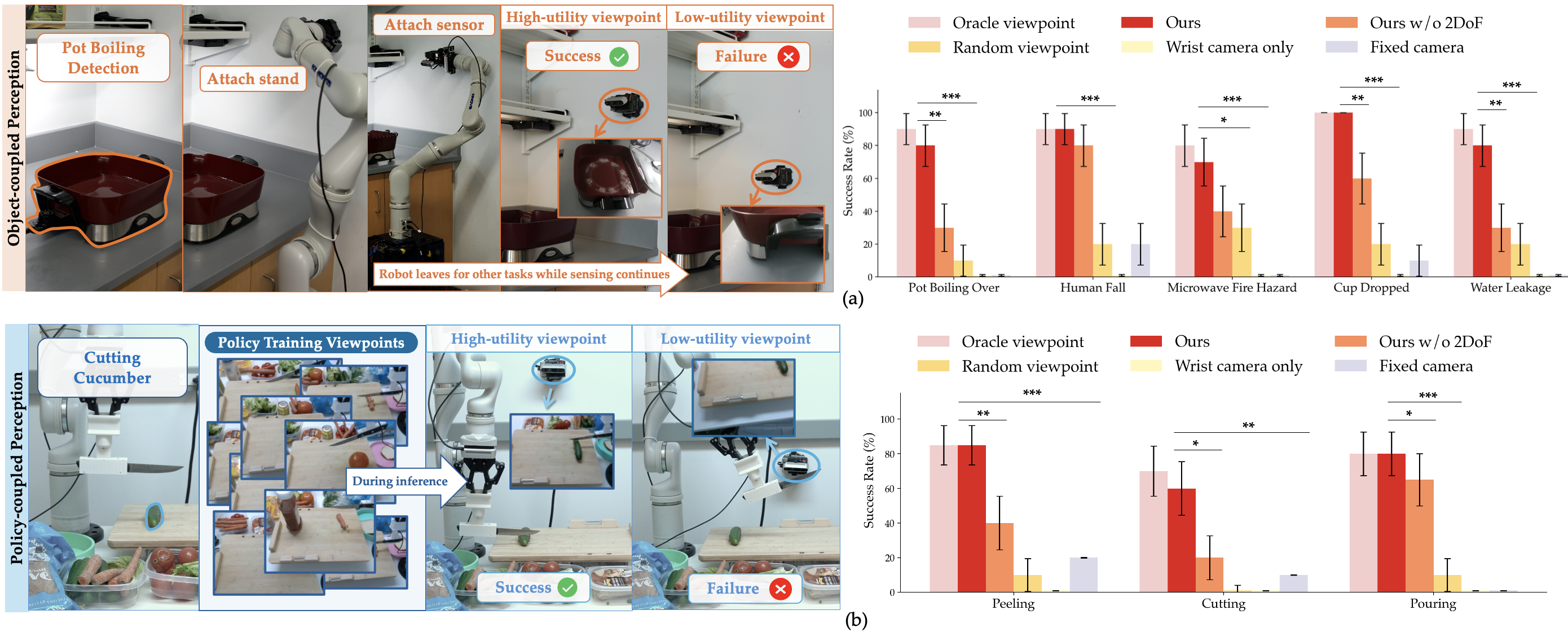
Existing robotic perception is constrained by sensors that are either robot-mounted or permanently fixed in the environment, locking perception to a limited set of viewpoints. Yet as robots perform increasingly diverse tasks, the most informative viewpoint shifts from one task to the next-often somewhere onboard sensor and static infrastructure can not readily satisfy. To address this gap, we propose SensorPerch, a novel realization of active perception that decouples sensing from both the robot embodiment and the environment by treating sensors as independent physical entities that the robot can autonomously detach and re-attach within the environment. SensorPerch presents one realization of this paradigm: a lightweight, wireless, reconfigurable sensor platform that can perch on diverse surfaces, paired with a viewpoint-selection framework that determines task-optimal sensor placements. Together, these enable robots to construct task-relevant viewpoints on demand, independent of the robot's current position and available fixed infrastructure. We demonstrate the paradigm on two task classes: (i) object-coupled perception, where SensorPerch enables persistent object-state detection beyond the robot's current position, achieving successful event detection even when the robot is not nearby; and (ii) policy-coupled perception, where SensorPerch allows robots to construct diverse, policy-specific viewpoints for various policies, achieving success rates comparable to those obtained using oracle viewpoints.
We propose a novel realization of active perception, SensorPerch, that treats sensors as independent physical entities that the robot can autonomously detach and re-attach within the environment, so that sensors can be placed wherever a task needs them. Sensors are neither permanently attached to the robot's kinematic structure nor installed as fixed infrastructure; instead, they temporarily perch in the environment.
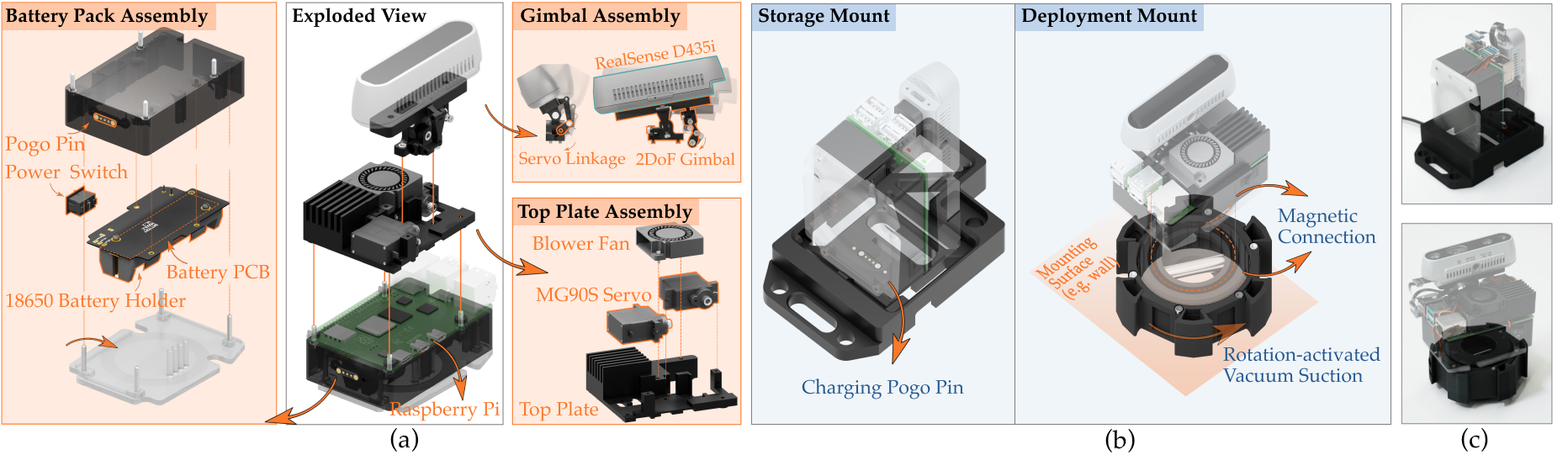
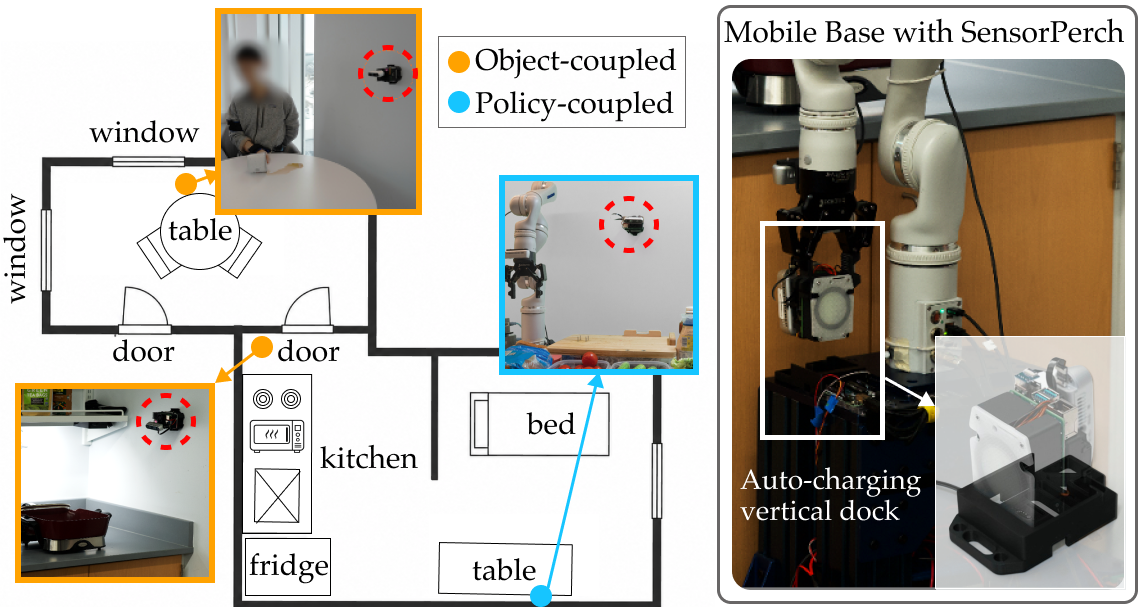
Our SensorPerch platform can be attached to diverse environmental surfaces. When sealed to a surface, our vacuum stand and magnetic interface between the stand and the sensor module provide strong mechanical support in both shear and pull-off directions. When a SensorPerch platform is idle, it is returned to the vertical docking station on the robot's mobile base for automatic recharging.
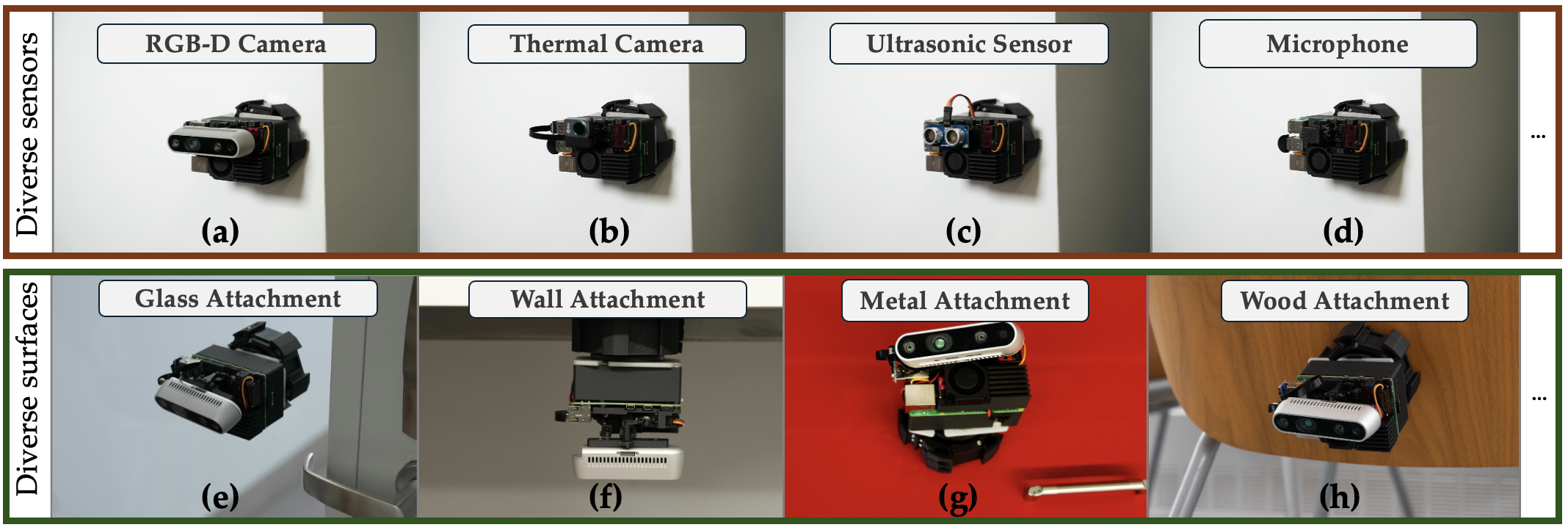
We evaluate SensorPerch with real-robot experiments across two task classes spanning 8 tasks: object-coupled perception, which enables persistent object-state estimation beyond the robot's current position, and policy-coupled perception, which autonomously places sensors at policy-required viewpoints for downstream inference. Across these experiments, SensorPerch successfully detects object states beyond the robot's immediate field of view and achieves policy-execution success rates comparable to oracle thirdperson viewpoints, demonstrating that perception can be treated as a reconfigurable resource rather than a capability fixed by embodiment or pre-installed infrastructure.
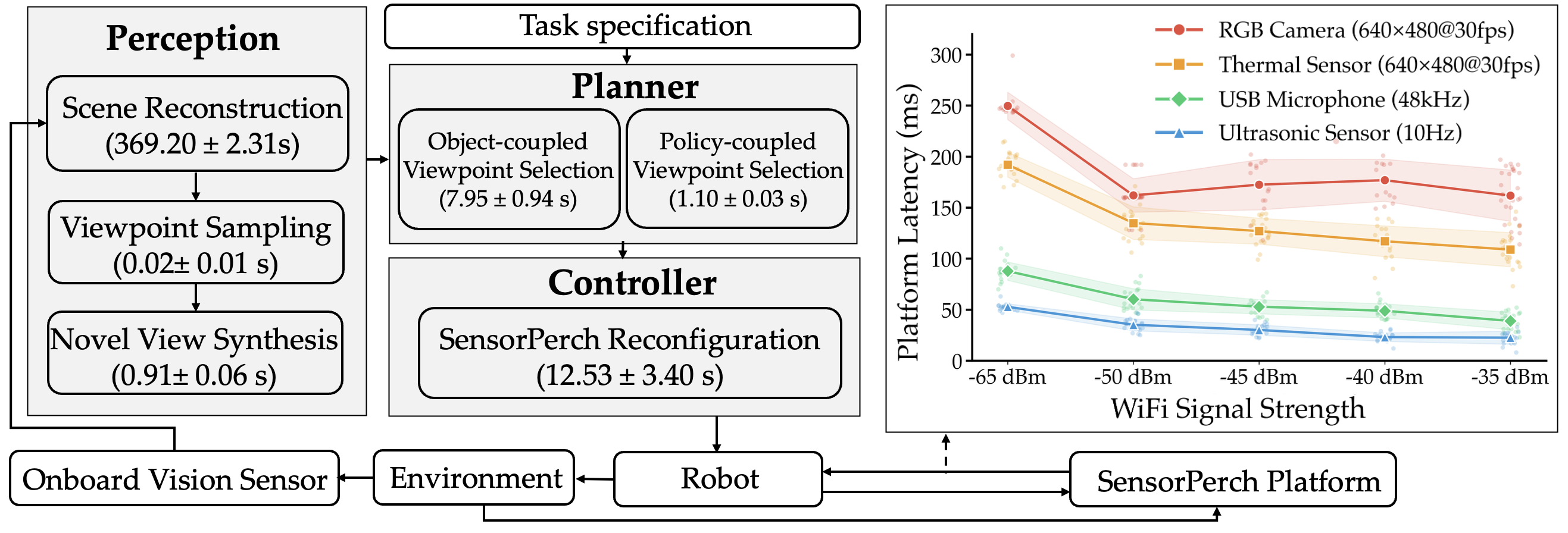
Beyond task effectiveness, we analyze the computational efficiency of our system to assess practical usability. We report the latency breakdown of the system and the streaming latency of the SensorPerch platform.
@misc{wu2026sensorperchsensematters,
              title={SensorPerch: Sense Wherever and Whenever it Matters},
              author={Zhanxin Wu and Ruofei Tong and Tapomayukh Bhattacharjee},
              year={2026},
              eprint={2607.10682},
              archivePrefix={arXiv},
              primaryClass={cs.RO},
              url={https://arxiv.org/abs/2607.10682}
          }