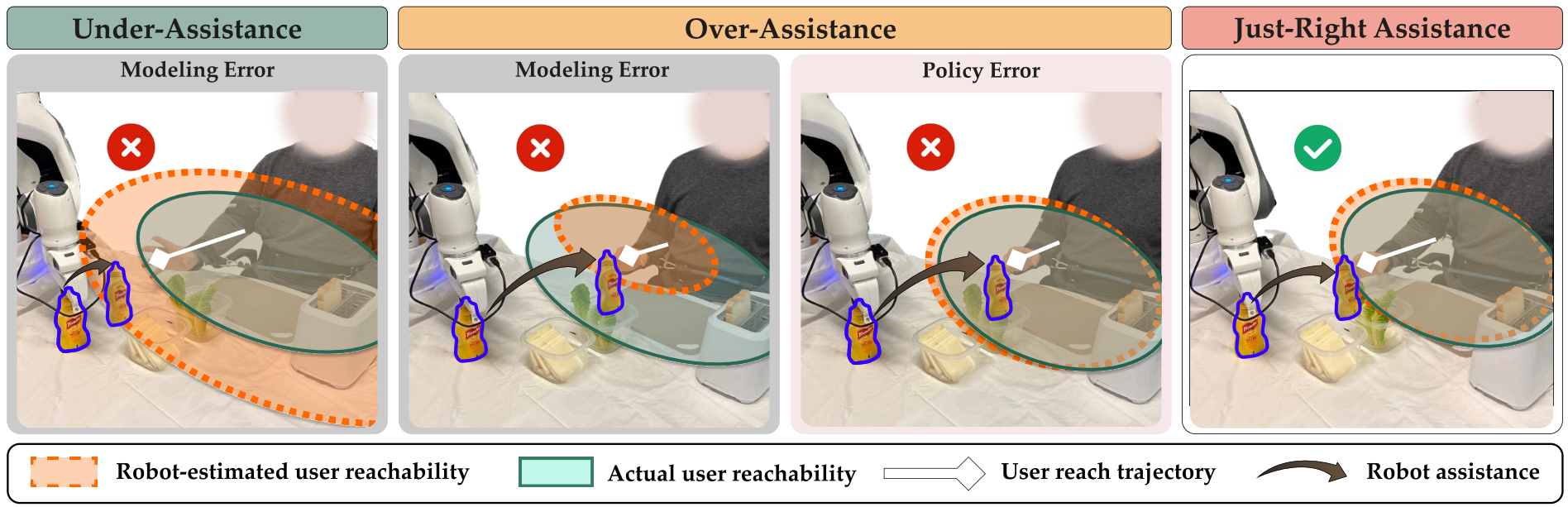
Approach
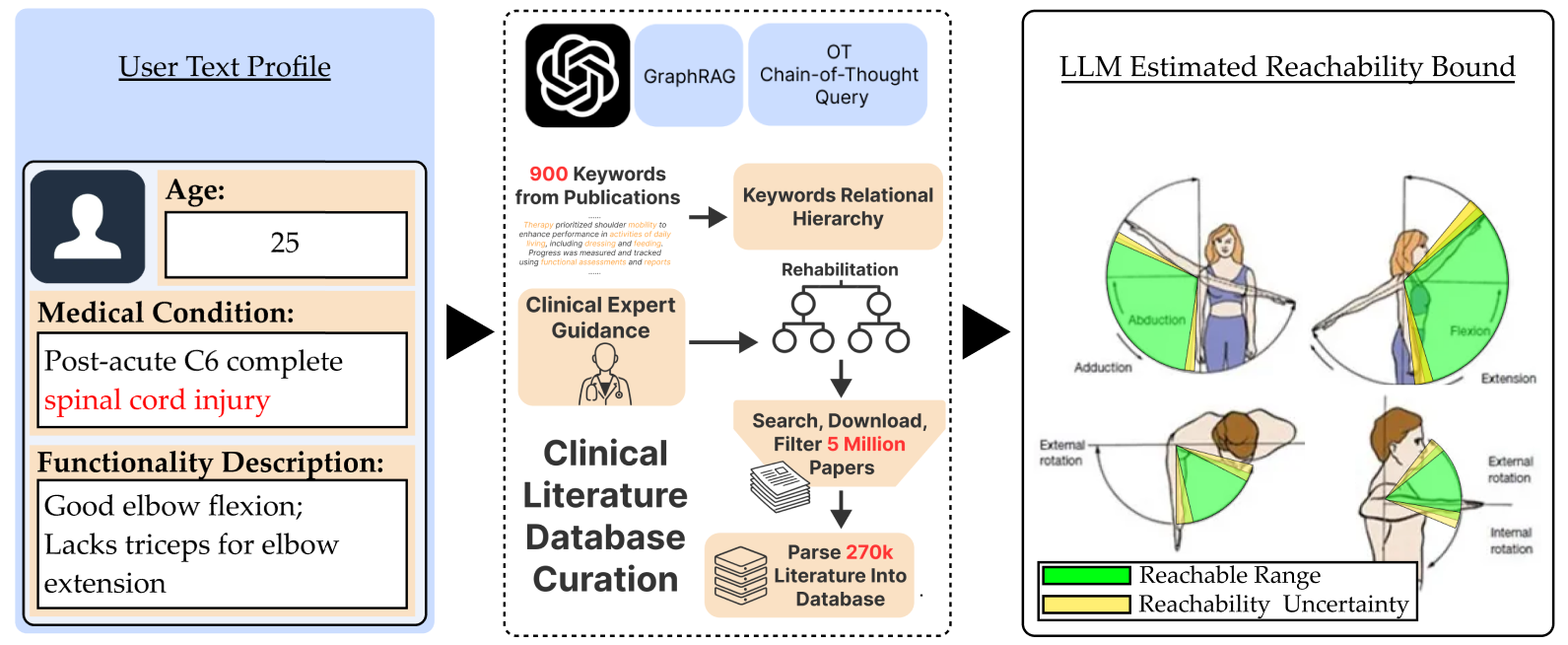
This module grounds reachability estimation in clinical and biomechanical knowledge before the robot starts querying the user.
Clinical anchors from rehabilitation literature and biomechanical anchors from simulation guide the model toward realistic, conservative functionality estimates.
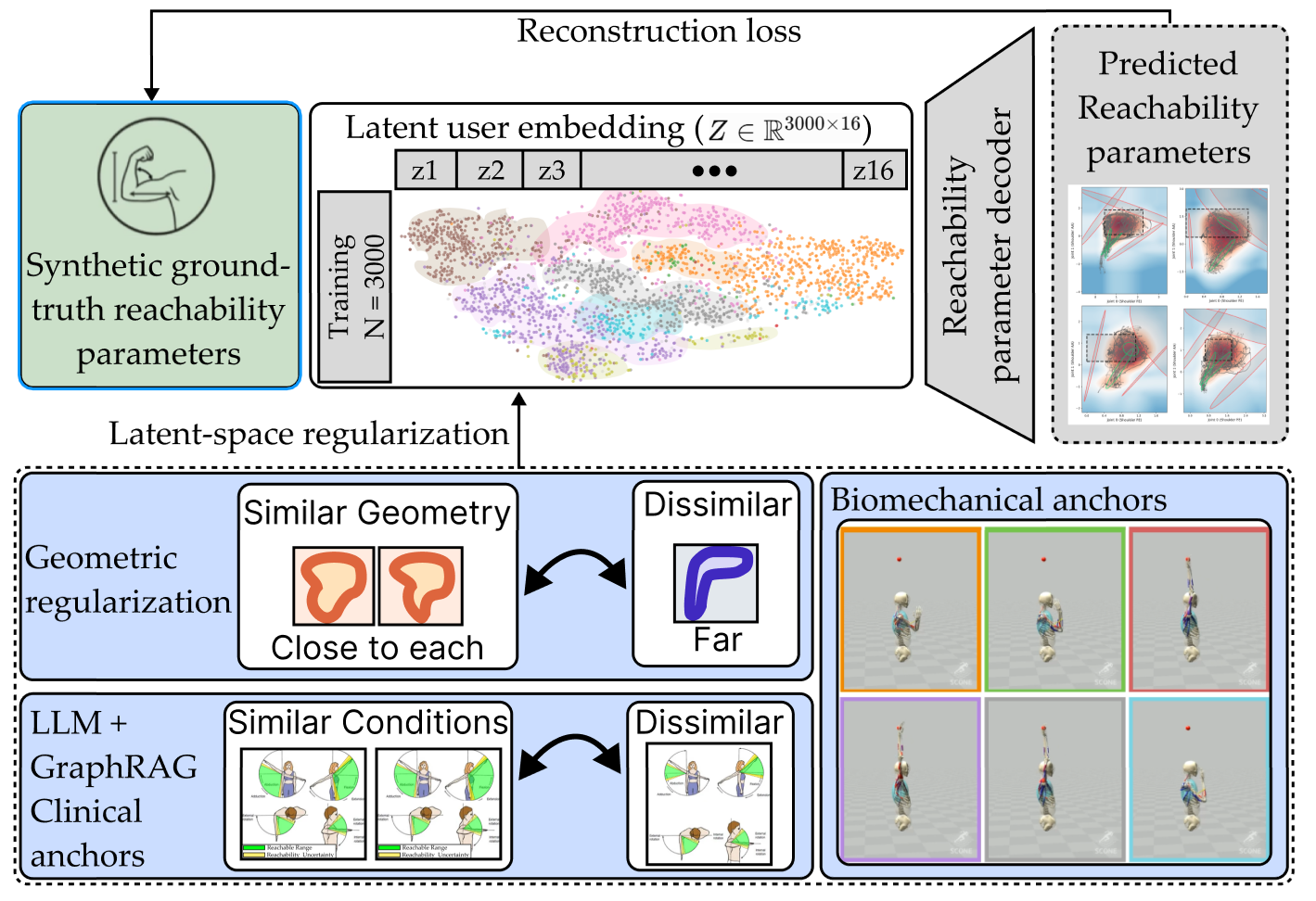
This module represents the user's reachable joint-space envelope with a structured latent model.
The learned latent space decodes to reachability parameters, allowing the robot to reason over plausible user-specific envelopes from sparse interaction outcomes.
The robot maintains a belief over the user's reachability and actively selects calibration queries that are expected to be most informative.
As the user responds, the robot updates its estimate online, enabling assistance that adapts when reachability changes due to fatigue, constraints, or task context.
Evaluations
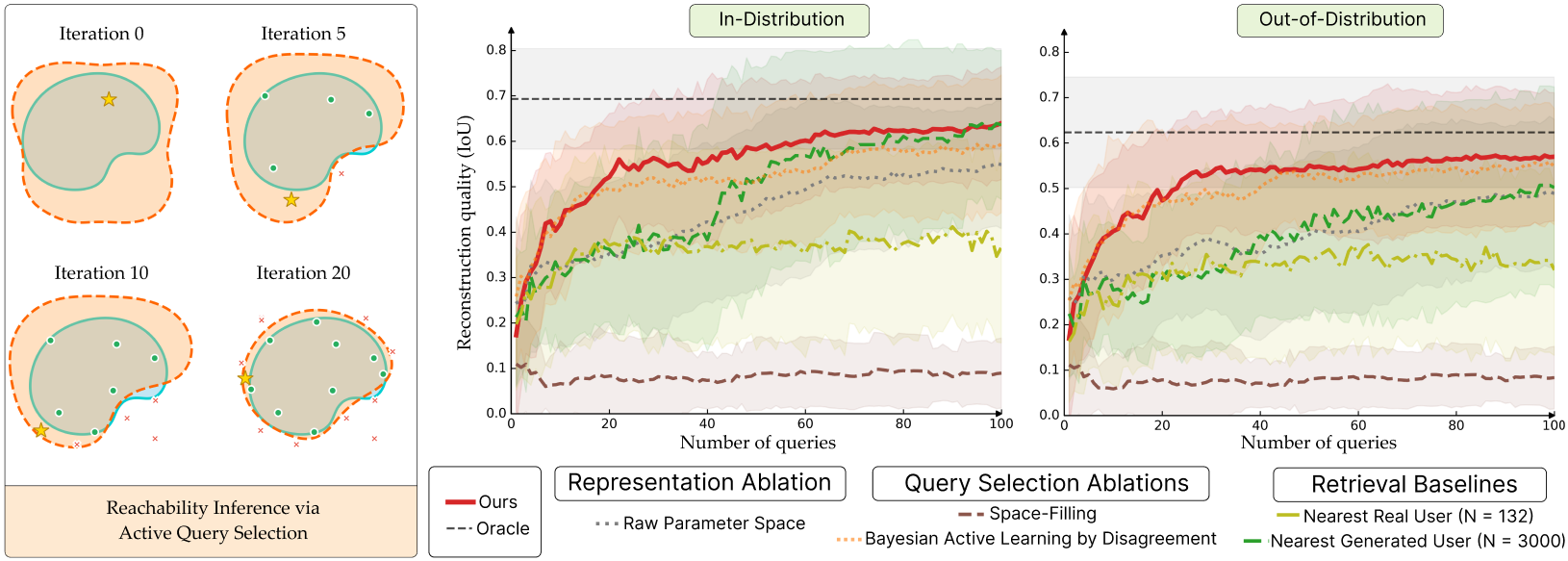
The computational evaluation tests whether the active estimator can recover useful user-specific reachability models from a small number of queries.
The method reaches approximately 0.50 IoU within 20 interactions, showing data-efficient estimation under sparse observations.
In the sandwich-making study, the robot uses reachability estimates to place ingredients near the user's reachable boundary instead of always moving items close.
This reachability-aware assistance supports physical engagement while maintaining task success and avoiding additional workload.
In the Action Research Arm Test inspired task, the robot places objects at the estimated reachability boundary and updates its belief after user interaction.
This study demonstrates online adaptation as the user's reachable workspace changes during physical assistance.
BibTeX
@inproceedings{liu2026knowing,
  title={Knowing When Not to Help: Active Estimation of Human Reachability for Just-Right Robot Assistance},
  author={Liu, Ziang and Yan, Yunting and Cheung, Christy and Ying, Tailai and Liu, Bodong and Tong, Shiqin and Orkwis, Alexander and Dimitropoulou, Katherine and Bhattacharjee, Tapomayukh},
  booktitle={Robotics: Science and Systems (RSS)},
  year={2026},
  url={https://emprise.cs.cornell.edu/human-reachability/}
}